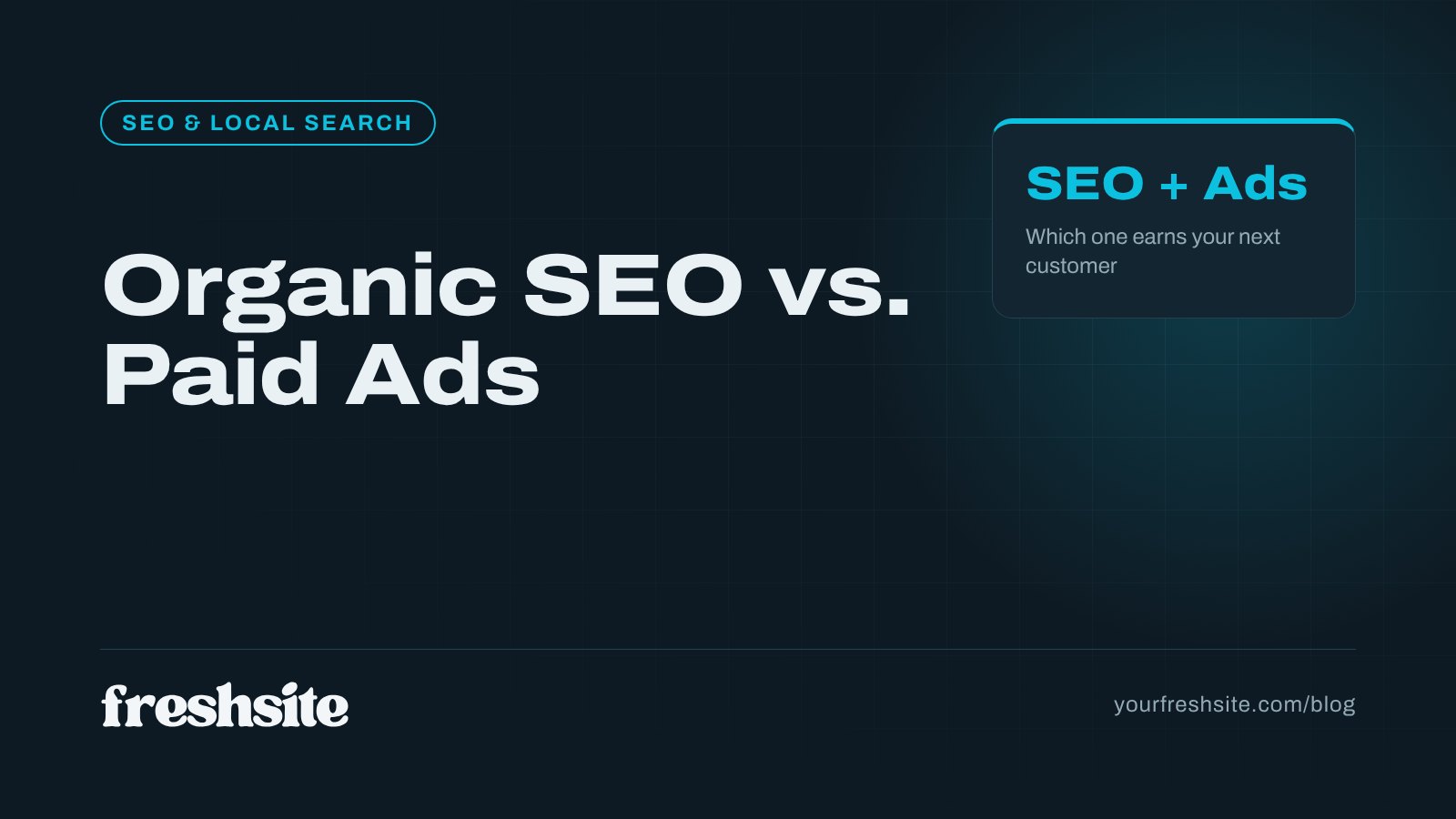
Paid ads are like renting a billboard. Organic SEO is like owning the building. Both have a place in a small business marketing plan, but they work in very different ways.
Key takeaways
- Paid ads bring traffic immediately, but the traffic stops the day the budget does.
- Organic SEO takes months to build, then keeps producing leads without a per-click cost.
- Organic search drives the majority of trackable website traffic, roughly three and a half times what paid search delivers.
- Most small businesses should use ads to fill gaps early, while investing steadily in SEO they'll own long-term.
Organic SEO vs. paid ads: the basic difference
When someone searches Google for "accountant near me" or "trucking company Fort Smith," they see two kinds of results. Paid ads appear at the top, marked "Sponsored." Below them, and in the local map pack, are the organic results Google ranks on its own.
Paid search (Google Ads, Microsoft Ads) lets you buy placement. You choose keywords, set a budget, and pay each time someone clicks. Results can start the same day.
Organic SEO is the work of earning placement. Google ranks pages based on relevance, quality, speed, and trust signals like reviews and links. You don't pay per click, but it takes time and steady effort to climb.
Why organic search matters so much
Across thousands of websites, BrightEdge research found organic search drives about 53% of all trackable traffic, compared with roughly 15% from paid search. For B2B companies, search overall accounts for an even larger share.
Local behavior points the same way. In BrightLocal's 2026 consumer research, 52% of people started their most recent local business search on Google, and consumers named clear, complete business information, strong reviews, and clear pricing as the top factors in which business they contacted. Those are all things you build organically, not things you buy.
There's also a trust factor. Many people scroll past anything labeled "Sponsored" and click the first organic or map result instead. Ranking organically signals that Google, not your ad budget, put you there.
The pros and cons of each
Paid ads: strengths
- Speed. A well-built campaign can generate calls the week it launches.
- Control. You choose the keywords, locations, schedule, and budget.
- Testing. Ads are a fast way to learn which services and messages bring in customers.
- Seasonality. They're perfect for tax season, open enrollment, or a summer tutoring push.
Paid ads: weaknesses
- The meter never stops. When the budget runs out, so do the leads.
- Rising costs. Competitive industries like legal, insurance, and financial services can see very high costs per click.
- They need a good landing page. Ads send traffic to your website. If the site is slow or confusing, you pay for clicks that never convert.
Organic SEO: strengths
- It compounds. A service page that ranks this year can keep bringing in leads for years.
- No cost per click. Your cost per lead falls as rankings grow.
- Trust. Strong organic rankings and reviews make you look like the established choice.
Organic SEO: weaknesses
- It takes time. Expect months, not days, before results show up in a meaningful way.
- It needs a solid foundation. A slow, thin, or outdated website makes ranking much harder.
- It requires consistency. Reviews, content, and profile updates have to keep happening.
Local SEO: where small businesses win
For a local business, organic SEO mostly comes down to three things.
1. Your Google Business Profile
Your profile is what appears in the map pack and on Google Maps. According to Google, people are 2.7 times more likely to consider a business reputable when they find a complete profile, and 70% more likely to visit. Fill in every field, choose accurate categories, add real photos, and post updates regularly.
2. Reviews
Reviews influence both rankings and decisions. BrightLocal's 2026 survey found 97% of consumers read reviews for local businesses, and 89% expect owners to respond. Ask every happy customer, make it easy with a direct link, and reply to every review, good or bad.
3. A website built for search
Your website has to tell Google exactly what you do and where. That means a dedicated page for each core service, location information, fast load times, proper titles and descriptions, and schema markup that helps search engines read your business details. A single "Services" page listing everything rarely ranks for any of it.
How to split your budget
There's no single right ratio, but this framework works for most small businesses:
- New business or new website: Lean on paid ads for leads (around 60 to 70% of the marketing budget) while you build your site, profile, and reviews.
- Six to twelve months in: As organic rankings and reviews grow, shift toward a 50/50 split.
- Established rankings: Keep ads for seasonal pushes, competitive keywords, and new services, and let organic carry the baseline (often 60 to 70% organic).
Whatever the split, measure cost per lead and cost per customer, not clicks or impressions. A channel that brings fewer visitors but more signed clients is the better channel.
How to measure what's working
Whichever mix you choose, track results by leads, not just traffic. Set up conversion tracking for form submissions and phone calls, and look at where each lead came from. For ads, compare cost per lead against the value of a new customer. For organic search, watch which pages bring in visitors who contact you.
Give SEO time. Most local businesses see meaningful movement over three to six months, while ads produce leads as soon as they're live. Reviewing both each month lets you shift budget toward what's actually bringing in customers.
Why your website comes first either way
Here's the part most ad agencies don't mention: both channels send people to the same place. Ads buy the click, and SEO earns it, but your website does the converting. A fast, clear, trustworthy site lowers your ad costs and helps you rank. A slow or dated one quietly wastes both.
That's why every FreshSite build includes search basics from day one: schema markup, an XML sitemap, fast load times, and pages structured around the services your customers search for. Our Growth plan adds full on-page SEO, service area pages, and a keyword-optimized blog post every month, so your organic traffic keeps growing while you run the business. See how the plans compare.
Frequently asked questions
Is SEO or Google Ads better for a small business?
Most small businesses need both, in different proportions over time. Paid ads deliver leads immediately but stop the day you stop paying. Organic SEO takes months to build but keeps producing traffic without a per-click cost. A common approach is to lean on ads early while SEO matures, then shift budget toward organic as rankings grow.
How long does SEO take to work?
For a local business with a well-built site, early movement often shows up in two to four months, with meaningful results in six to twelve months. Competitive industries and markets take longer. Google Business Profile improvements can show results faster than website rankings.
How much should a small business spend on Google Ads?
There's no universal number, because costs per click vary widely by industry and city. Start with a budget you can sustain for at least 60 to 90 days, track cost per lead rather than clicks, and only scale campaigns that produce customers at a profitable cost.
Can I do SEO myself?
You can handle a lot of local SEO yourself: keep your Google Business Profile complete, ask happy customers for reviews, and make sure your site has a page for every service you offer. The technical side, including site speed, schema markup, and page structure, is where professional help usually pays off.