People rarely hire a lawyer on impulse. They research, compare, and read, usually on a phone and often late at night, and your website is doing the talking before you ever do.
Key takeaways
- Most legal clients research attorneys online, even when they also get a referral.
- Your homepage should make your practice areas, service area, and next step obvious in seconds.
- Each practice area needs its own page, written for the person with that specific problem.
- Credentials, reviews, and responsiveness are what turn a visitor into a consultation.
How clients find a lawyer today
Referrals still matter in legal work, but they're no longer the whole story. Clio's Legal Trends research found that 57% of legal consumers did their own research to find a lawyer, and only a small share relied solely on a referral without checking the attorney out online. Clio's 2025 report adds a newer twist: about half of future clients have already asked an AI tool for legal help before contacting a firm.
That means even your best referrals land on your website before they pick up the phone. If the site looks dated, loads slowly, or doesn't clearly mention the type of case they have, the referral can quietly go elsewhere.
What visitors need to see in the first five seconds
Someone dealing with a divorce, an arrest, or a business dispute is stressed and short on time. Your homepage should answer three questions immediately:
- Do you handle my kind of case? Name your practice areas plainly.
- Do you work where I am? Mention the cities, counties, or courts you serve.
- What do I do next? One clear button, such as "Request a consultation," and a tap-to-call phone number.
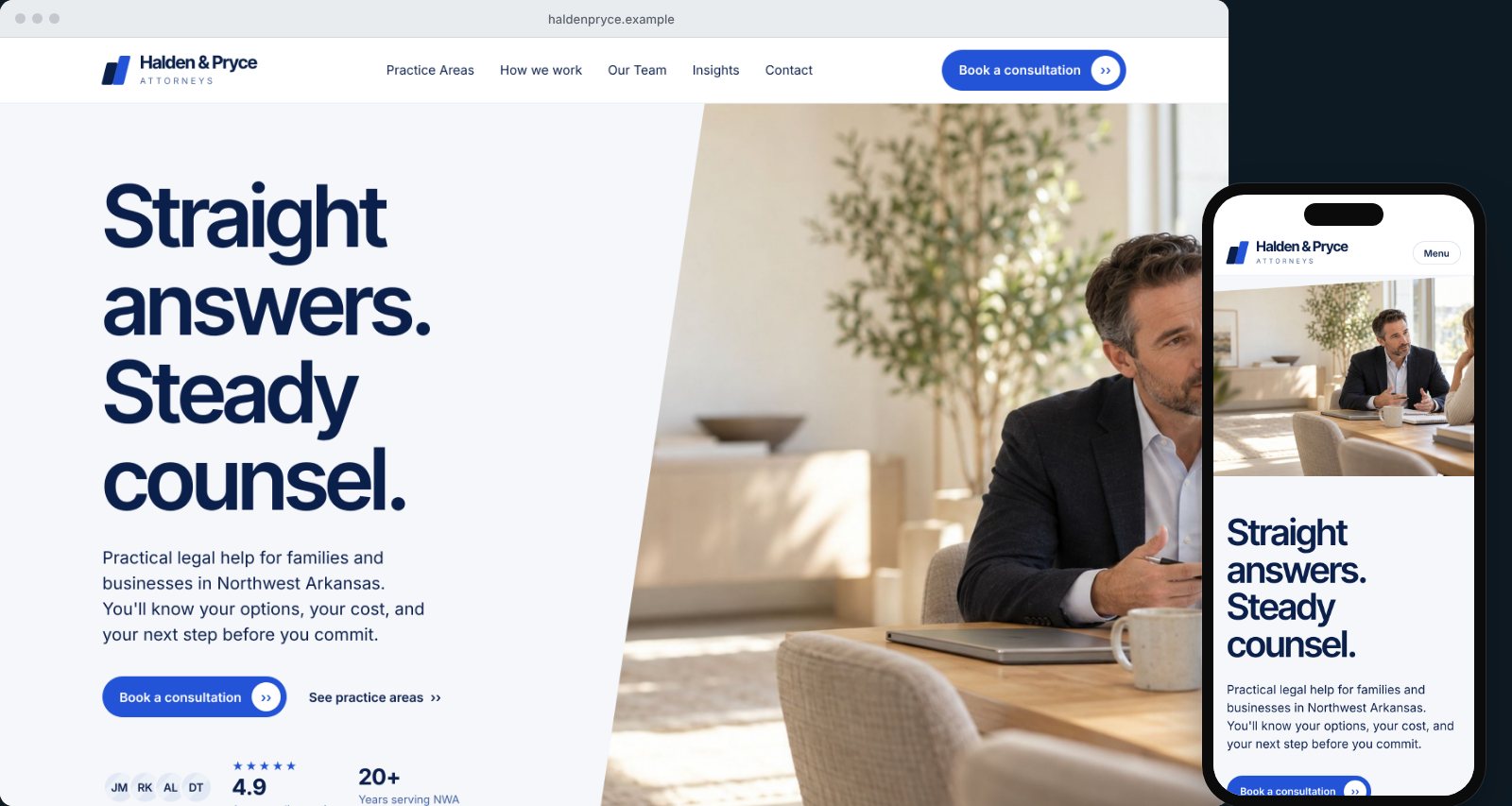
Look at the sample law firm homepage we built for a fictional firm: a confident headline, a short line about who the firm helps, and a consultation button above the fold, with the attorneys introduced right after.
Practice area pages: your biggest SEO opportunity
A single "Practice Areas" page listing everything you do won't rank for much of anything. People search for their specific problem, so each core practice area deserves its own page. A strong practice area page includes:
- A headline that names the service and the location ("Business Litigation Attorneys in Northwest Arkansas").
- Who the page is for and the situations you help with.
- How the process typically works and what clients can expect.
- The attorneys who handle these matters, with credentials.
- Answers to common questions, written in plain language.
- A clear way to start, repeated at the end of the page.
Our sample business litigation page follows this structure: a clear scope, the attorney behind the work, and a direct line to request a consultation.
Trust signals that matter most for law firms
Attorney bios with real credentials
Clio found that 77% of consumers want to know a lawyer's experience and credentials. Give every attorney a real bio with a professional photo, bar admissions, education, practice focus, years of experience, and something human, such as why they practice this area of law.
Reviews and client feedback
Reviews carry enormous weight in local decisions; BrightLocal's 2026 survey found 97% of consumers read reviews for local businesses. Where your state bar's rules allow, display recent reviews near your calls to action and link to your Google profile. Check your bar's advertising rules before publishing testimonials or case results, since many states require disclaimers.
Responsiveness
Clio's testing has repeatedly found that many firms are slow to respond to new inquiries, or don't respond at all. Your website can't answer the phone, but it can set expectations ("We reply to every inquiry within one business day") and route inquiries cleanly so nothing gets lost.
Consultation forms that get the right details
Long intake forms scare people off. Short forms that ask nothing useful waste your team's time. The sweet spot is a form that captures who's reaching out, how to reach them, the practice area, and a brief description of the situation, nothing more.
Two practical notes for law firms:
- Add a disclaimer that submitting the form doesn't create an attorney-client relationship, and ask visitors not to include confidential details.
- Capture the practice area with a dropdown so the right attorney gets the inquiry fast.
See it in action on our sample law firm contact page.
Local SEO for law firms
Most legal searches are local: "custody lawyer Fayetteville," "DWI attorney Rogers," "estate planning near me." To compete in the map pack and local results:
- Keep your Google Business Profile complete, with the most specific category (for example, "Family Law Attorney").
- Earn and respond to reviews consistently.
- Make sure your firm's name, address, and phone match exactly on Google, Avvo, Justia, your bar listing, and your website.
- Build practice area pages and, if you serve several cities, location pages with genuinely local information.
- Use schema markup so search engines can read your firm's details correctly.
Design and speed still matter
A law firm website should feel calm, credible, and current. Readable type, plenty of white space, real photos of your attorneys and office, and a design that works perfectly on a phone go further than any stock photo of a gavel. And because most legal searches happen on mobile, the site has to load fast, with main content in under about 2.5 seconds.
Common law firm website mistakes
- Listing every practice area on one page. A single "Practice Areas" list can't rank for anything specific. Separate pages can.
- Stock photos of gavels and scales. Every firm uses them, so they say nothing about you. Real photos of your attorneys and office build far more trust.
- Hiding the phone number. Many legal clients are stressed and want to talk to a person now. Keep a tap-to-call number in the header on every page.
- No explanation of fees. Even a short note on free consultations, contingency fees, or flat-fee services removes a major reason people hesitate to call.
- Slow follow-up. A great website is wasted if inquiries sit overnight. Decide who answers web leads and how fast.
Content that keeps bringing in clients
Most legal searches are questions: "How long does probate take in Arkansas?" "Do I need a lawyer for a small business contract?" "What happens at a first DWI court date?" A firm that answers those questions clearly, in plain English, earns search traffic and trust at the same time.
You don't need to publish constantly. One well-researched article a month, built around a question your clients ask in consultations, adds up to a library that works for you around the clock. Keep articles informational rather than promotional, note that they aren't legal advice, and link each one to the matching practice area page so interested readers can take the next step.
Review older articles once a year. Laws change, and an outdated article can hurt credibility more than having none at all.
How FreshSite builds law firm websites
FreshSite builds custom websites for small and midsize law firms with practice area pages, attorney bios, consultation forms, and search basics included from day one, then hosts, secures, and maintains them for one monthly price. Plans start at $59 a month with a $299 setup fee and run month to month after three months.
See more of our work on the law firm websites page, or tell us about your firm.
Frequently asked questions
What should a law firm website include?
At minimum: a clear statement of your practice areas and service area on the homepage, a separate page for each practice area, attorney bios with credentials, reviews or client results where your state bar allows them, a short consultation form, a tap-to-call phone number on every page, and fast mobile performance.
How much does a law firm website cost?
Legal-focused agencies often charge $10,000 to $30,000 or more for a custom build plus monthly retainers. Freelancers range lower. FreshSite builds custom law firm websites starting at $59 a month with a $299 setup fee, including hosting, security, and maintenance.
Do practice area pages really help with SEO?
Yes. People search for specific problems, such as a DUI lawyer, a child custody attorney, or a business litigation firm, not just 'lawyer.' A dedicated page for each practice area gives Google a clear match for those searches and gives visitors the specific answers they came for.
Can law firms use client testimonials on their website?
Rules vary by state. Many bars allow testimonials and reviews with appropriate disclaimers, while some restrict how results and endorsements are presented. Check your state bar's advertising rules, and have your site reviewed with those rules in mind.