Shippers have options, and they do their homework. By the time a logistics manager calls you, they've usually already looked at your website and decided whether you look like a serious, reliable partner.
Key takeaways
- B2B buyers spend more time researching online than meeting with vendors.
- Shippers want proof of reliability: equipment, lanes, safety, and authority.
- A fast, specific quote form is the most important page on the site.
- Your website doubles as a driver recruiting tool.
Shippers research before they call
Gartner research found B2B buyers spend only about 17% of their purchasing time meeting with potential suppliers, and that time is split among every vendor they're considering. They spend more time, around 27%, researching independently online.
BrightEdge research found organic search drives the majority of B2B website traffic. For a carrier, freight broker, or warehouse, that means your website is quietly doing most of the early selling. If it's thin, outdated, or hard to use on a phone, you may never even get the call.
What the first screen should say
- What you move and how: dry van, flatbed, reefer, LTL, warehousing, brokerage.
- Where you run: regional, national, specific lanes, or cross-border.
- Why you're reliable: on-time rate, years in business, fleet size, safety rating.
- How to get a quote, with a button that leads to a short form and a phone number for dispatch.
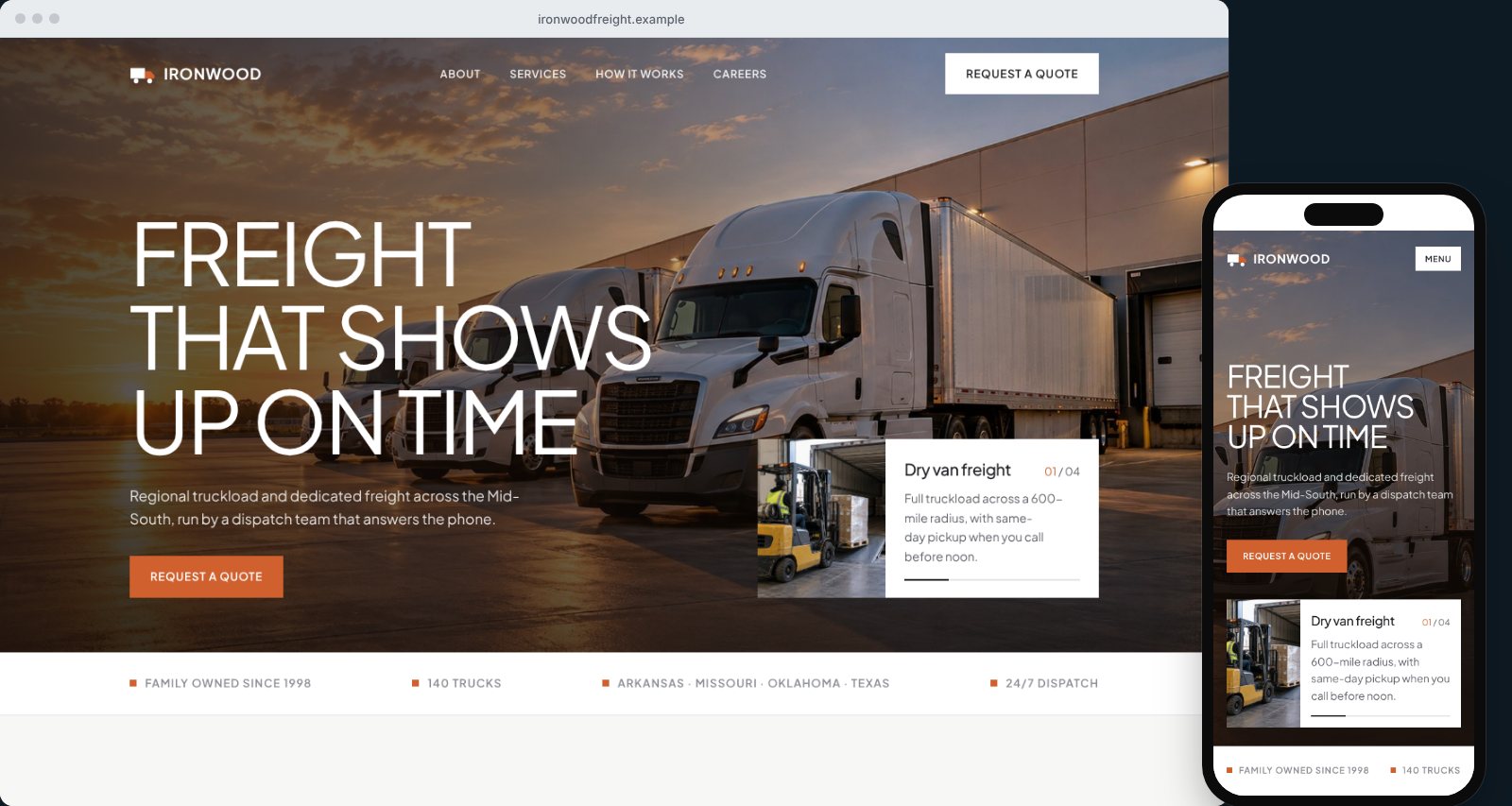
Our sample freight homepage leads with a strong headline, a quick list of services, real truck photography, and a quote button in the header.
Service pages for every mode and offering
Logistics buyers search specifically: "temperature controlled freight Arkansas," "cross-dock warehouse Dallas," "expedited LTL." Give each service its own page that covers:
- What the service is and when shippers use it.
- Equipment, capacity, and coverage area.
- Industries you serve, like retail, food and beverage, or manufacturing.
- Technology: tracking, EDI, portals, and reporting.
- A quote form or call to action specific to that service.
See our sample warehousing page, which covers capacity, services like pick-and-pack and cross-docking, and the systems that keep inventory visible.
Proof of reliability
Trust in logistics is built on numbers and specifics:
- USDOT and MC numbers, and links to your safety record.
- Fleet size and equipment types, with real photos of your trucks and facilities.
- Performance stats like on-time delivery rate or claims ratio, stated honestly.
- Certifications such as SmartWay, C-TPAT, or food-grade standards.
- Case studies or short stories about problems you've solved for shippers.
A quote form dispatch can actually use
Your quote request form is the most important conversion point on the site. Ask for what your team needs to quote quickly: origin and destination ZIP codes, freight type, weight, pallet count or dimensions, equipment, and ship date. Make extras optional, and say how fast you'll respond. Our sample quote page shows a clean, mobile-friendly layout.
Your website is a recruiting tool too
Finding good drivers is a constant challenge. A dedicated careers page often outperforms job board listings because drivers can see the real company. Include:
- Pay ranges and how pay works (per mile, percentage, or hourly).
- Home time and route types.
- Equipment drivers will run.
- Benefits, bonuses, and requirements.
- A short application that works on a phone.
SEO for logistics companies
- Create pages for each service and the regions or lanes you cover.
- Complete your Google Business Profile for each terminal or warehouse.
- Keep company details consistent across Google, load boards, and industry directories.
- Publish helpful content shippers search for, like guides to freight classes or choosing a 3PL.
Common logistics website mistakes
- Stock photos of someone else's trucks. Shippers and drivers notice. Your own fleet, terminals, and people build credibility.
- No lane or coverage information. A shipper needs to know if you run their routes. A simple map or list of states saves everyone time.
- A "contact us" form instead of a quote form. Generic forms produce vague requests that require back-and-forth. Ask for the details dispatch needs.
- Missing authority details. Leaving off USDOT and MC numbers makes cautious shippers wonder why.
- A site that breaks on phones. Many drivers and dispatchers browse on mobile. A quote or application that won't work on a phone is a lost opportunity.
Build pages for the industries you serve
Shippers trust carriers and 3PLs that understand their freight. A food distributor cares about temperature control and sanitation. A building products manufacturer cares about flatbed securement and job-site delivery. A retailer cares about appointment scheduling and retail compliance.
Industry pages let you speak to each of these buyers in their own language. Explain the challenges of their freight, the equipment and processes you use, and the customers you already serve in that space. These pages also capture valuable search traffic, because shippers often search by industry ("food grade trucking," "building materials freight") as well as by mode or location.
Measure quotes, not just visits
Traffic numbers can be misleading for logistics companies. What matters is how many qualified quote requests and driver applications your website produces, and how many turn into loads and hires. Track form submissions and calls from the site, and ask new shippers how they found you.
Review the results every month. If one service page brings in most of your quotes, expand it and build similar pages for related services. If driver applications start but don't finish, shorten the form. Small, regular improvements based on real results will do more for your pipeline than an expensive redesign every few years.
How FreshSite builds logistics websites
FreshSite builds custom websites for carriers, brokers, 3PLs, and warehouses with service pages, quote forms, careers sections, and search basics included, then hosts, secures, and maintains them for one monthly price. Plans start at $59 a month with a $299 setup fee.
See more on our logistics websites page, or tell us about your operation.
Frequently asked questions
What should a trucking company website include?
Your services and equipment, lanes or service area, safety record and authority information (like your USDOT and MC numbers), industries served, a fast quote request form, contact details for dispatch, and a careers section for driver recruiting.
Do logistics companies need SEO?
Yes. Shippers search for terms like 'flatbed carrier Arkansas' or '3PL warehousing near me,' and B2B organic search drives a large share of website traffic. Service and location pages built around those searches bring in qualified quote requests.
Should a trucking website have a driver recruiting page?
Absolutely. Driver hiring is a constant need, and a dedicated careers page with pay ranges, home time, equipment, and benefits, plus a short application form, often performs better than job boards alone.
How detailed should a freight quote form be?
Ask for what dispatch needs to quote quickly: origin and destination, freight type, weight, dimensions or pallet count, equipment needed, ship date, and contact details. Keep everything else optional so the form gets finished.