Insurance shoppers aren't loyal to a logo anymore. They compare, they click, and they choose whoever makes the process feel simple and trustworthy. That's an opening for local agencies.
Key takeaways
- Shoppers collect about three and a half quotes on average, and nearly half of new auto policies are bought online.
- Your website is where you win or lose the quote request.
- Independent agencies win by showing choice, local claims help, and real people.
- Most auto shoppers who own a home never get a homeowners quote, which is a cross-sell your website can fix.
Insurance shopping has gone digital
J.D. Power's 2026 U.S. Insurance Shopping Study found that nearly half of new auto policies are now purchased online, and shoppers collect an average of about three and a half quotes before deciding. More than half of auto insurance customers shopped for a new policy over the previous year.
That's a lot of comparison happening before anyone talks to an agent. The agencies that show up in search, look credible, and make requesting a quote painless get a place in that comparison. The rest never find out they were considered.
Lead with your independent advantage
Direct carriers spend heavily on advertising, but they can't offer what a local independent agency can:
- Choice: quotes from many carriers instead of one.
- Advice: someone who explains coverage in plain English.
- Claims help: a local person who answers the phone when something goes wrong.
- Relationships: an agent who knows the family, the business, and the history.
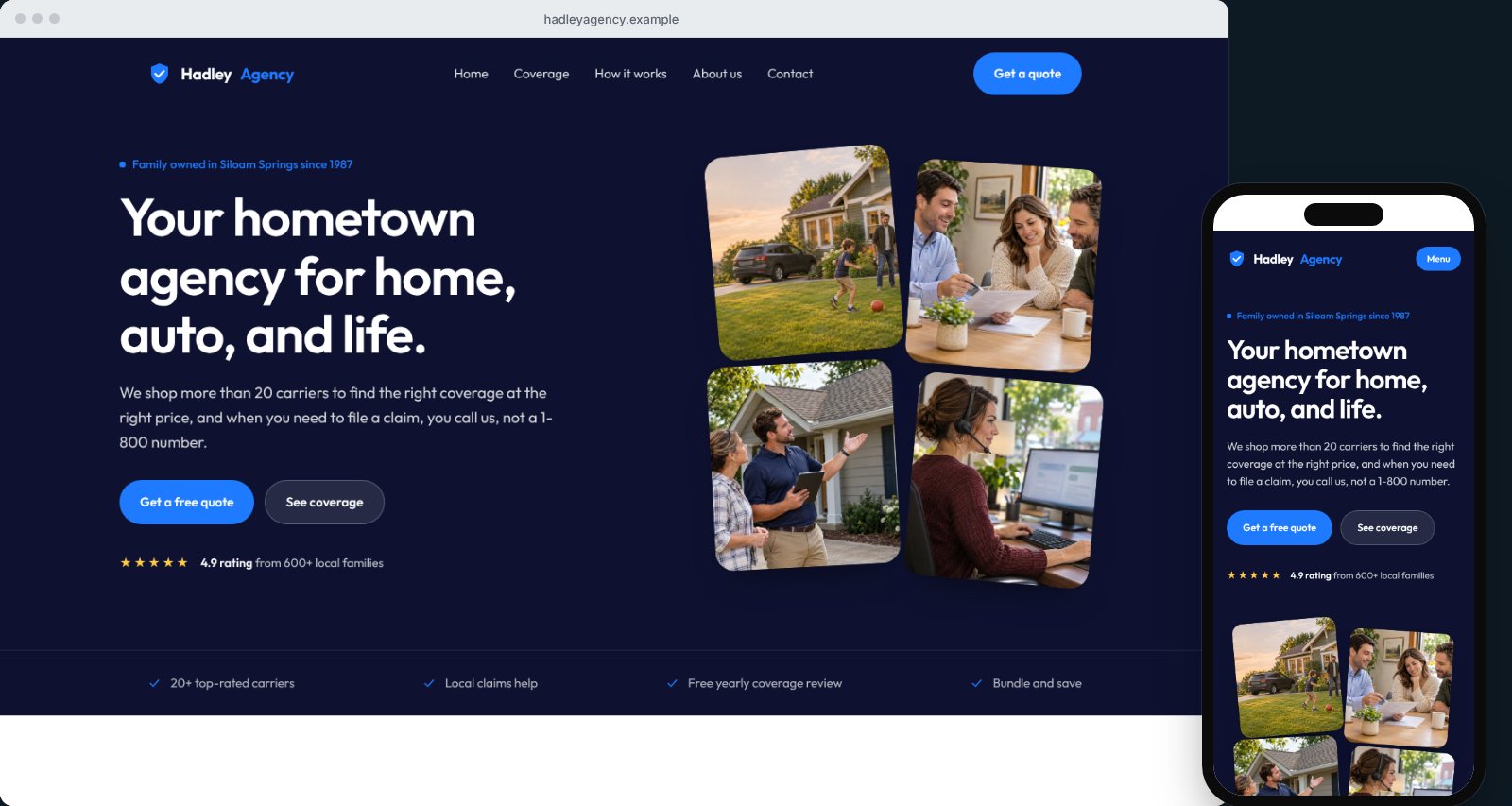
Your homepage should say this in the first screen. Our sample agency homepage does it with a clear headline ("your hometown agency for home, auto, and life"), a one-line promise about shopping more than 20 carriers, and a quote button.
A page for every line of coverage
People search for "small business insurance," "homeowners insurance Rogers," or "life insurance for young families," not for an agency name. Give each major line its own page with:
- Who needs it and what it covers, in plain language.
- Common add-ons and gaps people miss.
- Typical price ranges, clearly labeled as illustrations.
- How your quoting process works and how fast you respond.
- A quote request form tailored to that line.
Answer the price question honestly
Every shopper wants to know "what will this cost me?" Exact premiums depend on underwriting, but typical ranges for common situations, clearly labeled as estimates, set expectations and build trust. Our sample small business coverage page shows typical yearly ranges for general liability, a business owner's policy, and workers' comp, with a note explaining what drives the price.
Fix the cross-sell gap
One of J.D. Power's most striking 2026 findings: among auto shoppers who also own a home, only about one in five received a homeowners quote while shopping. Most shoppers are quoting one policy and moving on.
Your website can change that. Mention bundling on every auto page, ask "Do you own or rent your home?" in the quote form, and show typical bundle savings. Every extra line you quote is more value for the customer and a stickier relationship for you.
Quote forms that get finished
A quote form should ask only what you need to start: name, contact details, the coverage type, and a few qualifying questions, such as business type and employees for commercial, or vehicles and drivers for auto. Show what happens next, and promise a response time you can keep. See our sample quote request page.
Ask people not to enter driver's license numbers, Social Security numbers, or bank details in a general web form. Collect those securely later in the process.
Local SEO for insurance agencies
- Complete your Google Business Profile with the most specific category, such as "Insurance Agency."
- Ask every satisfied client, especially after a claim goes well, for a review, and respond to every one.
- Create pages for the towns you serve, with genuinely local details.
- Keep your agency's name, address, and phone consistent across Google, carrier "find an agent" directories, and your website.
Common insurance agency website mistakes
- A carrier-provided template site. Template sites look like every other agent's. A custom site lets your agency's personality and local roots come through.
- One generic quote form. Auto, home, life, and commercial need different questions. Tailored forms get better information and more completions.
- No claims guidance. When something goes wrong, clients look for help on your website. Add a claims page with carrier numbers and steps to take.
- No service area. Shoppers want a local agent. Name the towns and counties you serve.
- Ignoring existing clients. Make it easy to request policy changes, ID cards, or certificates of insurance online.
Use your website to keep clients, not just win them
With more people shopping their policies every year, retention matters as much as new business. Your website can help. A simple service page where clients can request changes, add a driver, or get a certificate of insurance shows responsiveness without adding phone time.
Seasonal content helps too. A spring article on storm preparation, a summer checklist for teen drivers, and a fall reminder to review coverage before renewal all give clients a reason to think of you before they think about shopping. Share each one by email and on social media, and link it to the right quote form so a quick review can become a new policy.
Measure quotes by line
Track quote requests by line of coverage, along with calls from your website, so you know what your site is producing. Ask every new client how they found you. Over time you'll see which lines and towns bring in the most business and where to build next.
If auto quotes are strong but home quotes lag, strengthen the bundling message. If commercial pages get visits but few requests, add clearer coverage explanations and typical price ranges.
How FreshSite builds insurance agency websites
FreshSite builds custom websites for independent agencies and solo agents, with coverage pages, quote forms, agent bios, reviews, and search basics included, then hosts, secures, and maintains them for one monthly price. Plans start at $59 a month with a $299 setup fee.
See more on our insurance agency websites page, or tell us about your agency.
Frequently asked questions
What should an insurance agency website include?
A clear list of the coverage you offer, the carriers or markets you work with, your service area, agent bios, reviews, a fast quote request form for each major line, claims help information, and a tap-to-call number on every page.
Should insurance agencies show prices on their website?
Exact premiums depend on underwriting, but typical ranges for common policies, clearly labeled as illustrations, answer the question shoppers care about most and set realistic expectations. Many agencies find that transparency builds more trust than it costs.
How can an independent agency compete with big carriers online?
By leaning into what direct carriers can't offer: choice across many carriers, local claims help, and a real person who knows the customer. The website should make those advantages obvious and make it easy to request a quote or talk to an agent.
How do I get more insurance leads from Google?
Keep your Google Business Profile complete and active, earn steady reviews, build a page for each line of coverage and each town you serve, and make the quote form fast on mobile. Pair that with Google Ads during peak shopping periods if you need leads quickly.
Sources
- Digital Becomes the New Front Door for Auto Insurance Shopping, J.D. Power 2026 U.S. Insurance Shopping Study
- J.D. Power: Consumers collecting historic number of auto insurance quotes, Repairer Driven News
- J.D. Power 2026 Insurance Shopping Study release, Business Wire
- Local SEO Statistics, BrightLocal